

How Does a Silent Disco Actually Work? A Behind-the-Scenes Breakdown
People always ask the same question the first time they hear about silent disco: "Wait — so there's no speakers? How does that even work?"
Fair question. Let me walk you through exactly how the technology works, what the setup looks like, and what the experience feels like from the moment you put on the headphones.
The Equipment
There are two core pieces of equipment in a silent disco: transmitters and headphones.
Transmitters are small devices connected to a music source — a phone, a laptop, a DJ controller, or even an MP3 player. The transmitter takes the audio signal and broadcasts it wirelessly to every pair of headphones within range. Think of it like a radio station, except the signal goes directly to your ears and nobody else hears it.
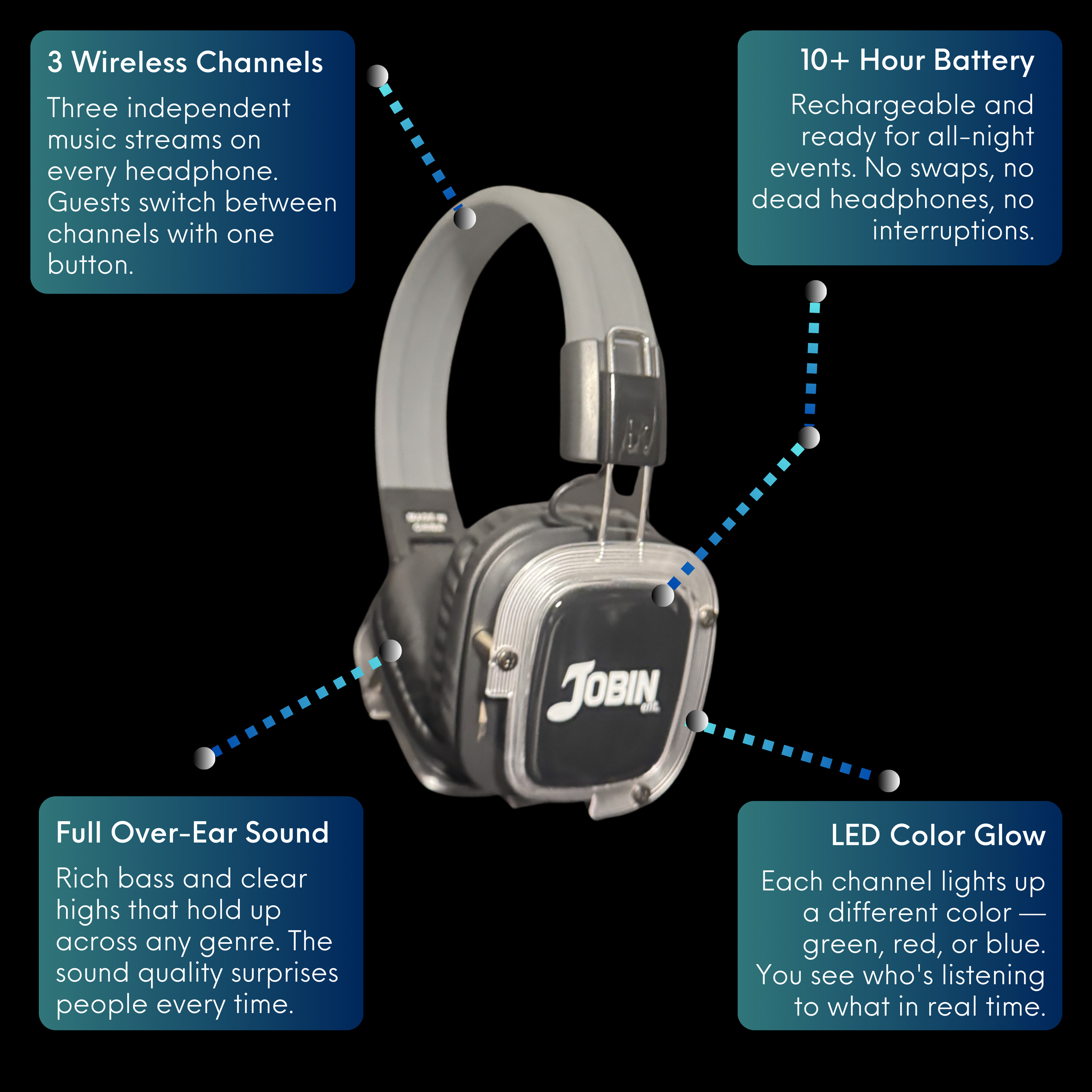
Each transmitter can broadcast on up to 3 separate channels. So if you have one transmitter, you can offer your guests three different music options at the same time.
Headphones are the guest-facing piece. They're wireless, over-ear, and designed to be comfortable for extended wear. Each pair has a channel selector and a volume dial. The headphones also have LED lights built into the ear cups — and the color changes depending on which channel you're listening to. Blue, red, and green are the standard colors.
Jobin Ent. runs 100 headphones and 6 transmitters. For a single event, one transmitter covers three channels. For larger operations, multiple transmitters can cover multiple zones or multiple events simultaneously.
The Setup Process
Here's what happens before a Jobin Ent. silent disco event:
30-60 minutes before the event our team arrives at the venue. The transmitter gets placed in a central location and connected to the music source. Headphones get laid out at a distribution point — usually a table near the entrance.
Music sources get tested. Each channel gets a sound check to make sure all three are broadcasting clearly. If there's a DJ, their setup gets wired into the transmitter. If it's a DIY rental (the client manages their own playlists), the client gets a quick walkthrough on how to connect their phone or laptop.
Headphones are charged and ready. Every pair arrives fully charged with 8-10 hours of battery life. That's more than enough for any event.
That's it. No speakers to haul. No sound system to configure. No acoustic considerations. The setup footprint is about the size of a small coffee table.
The Guest Experience
When a guest arrives, they grab a pair of headphones from the distribution point. They put them on, hit the power button, and immediately hear music. A button on the headphone lets them flip between the three channels.
Here's what makes it feel different from a regular party:
The moment you put on the headphones, the outside world drops away. The music is crisp and clear — not competing with crowd noise, not bouncing off walls. It's a direct, immersive connection to the sound.
You look around the room and see headphones glowing in three different colors. You can see who's on your channel and who isn't. It's a social experiment in real time — and people love switching channels to see what everyone else is hearing.
You take the headphones off and hear... people laughing, talking, and singing along to songs only they can hear. It's bizarre. It's hilarious. It's the most photographed moment at any silent disco event.
You control your volume. If you want it loud, crank it. If you want to chat with someone, turn it down or slide one ear off. You never have to shout over music again.
The Breakdown
At the end of the event, headphones get collected at the distribution point. Jordan handles the count, packs everything up, and the venue goes back to normal. The whole breakdown takes about 15-20 minutes.
What About Sound Quality?
This is the biggest surprise for first-timers. The sound quality through silent disco headphones is genuinely better than what you get at most bars and venues with speaker systems. There's no room acoustics to fight, no feedback, no dead spots. Every person gets studio-quality audio directly in their ears.
It's the reason silent disco yoga works. It's the reason silent disco weddings work. And it's the reason people dance harder at a silent disco than they do at a club with a $50,000 sound system.
Want to Experience It?
Come to one of Jobin Ent.'s free community pop-ups at a San Diego park. Or book one for your next event at [jobinent.com](https://jobinent.com).
---
*Jobin Ent. is a San Diego-based silent disco company operated by Jordan Mitchell out of North Park. For bookings and inquiries, visit jobinent.com or follow @Jobin.Ent on Instagram.*
